Showing posts with label Mathematics. Show all posts

Monday, November 14, 2011

A plate in Paris

Yes, Karen and Ted came all the way from California to bring me this beautiful glass plate in Paris more than two years ago!
Isn't it gorgeous?
I must say that, at first, I was surprised when they told me that it was inspired by my "Mathematics quilt".
I really think Ted did an amazing job.
Actually there are also some similarities between Ted's plate and my "Twelve" quilt, although he hadn't seen that quilt yet when he made the plate, (and I hadn't seen his plate when I made my quilt). Do you see the 12 little dots on his plate and the 12 cross stitches on my quilt? And then the curvy orange lines on his plate and the undulating line of beads on my quilt?

Thank you so much Ted for this beautiful gift!

Friday, November 11, 2011

A Fused Glass Quilt


As everyone knows, nine of the Twelves had a rendezvous at IQF in Houston. As part of this meeting, we exchanged some lovely gifts. They will not be shared until those who weren't there, get their packages in the mail. 

Karen's husband, a fused glass artist, made each of us a fused glass plate that was inspired by one of our Twelve by Twelve quilts. I received mine some time ago when Karen came to Portland for a visit. She has shipped plates to all of the twelves by now, and I hope they will share theirs, soon. I am anxious to see them all.

My beautiful plate was inspired by my mathematics themed quilt. A big thank you to Karen and Ted.

Tuesday, March 8, 2011

Book Release Celebration!
Introducing Chapter 7: Mathematics and Helen

Greetings from the UK!

;I bet you know how this works by now don't you?
There's a question at the end of this post. If you comment, giving us your answer, you go into a draw for a free copy of our book. And you make twelve quilters ridiculously happy to know that you are actually reading our blog and communicating with us! But please make sure that your comment includes a way for us to contact you in case you win or we shall be all sad not to be able to send you a nice glossy book.
The book drawing is closed.  Stay tuned for the winner details.
Twelve by Twelve Theme Series by Helen Conway
Given my inabilty to add 2 and 2 without a calculator, it is ironic that I get to introduce the Mathematics chapter. Although thinking about it, my quilt was inspired by an adult learning late in life to count change, so maybe it is not that odd. It was also about the Obama election and how people's votes were being counted - with some people participating in democracy for the very first time. Really our Twelve by Twelve project has worked so well not just because of the participation of the members but also because of the participation of readers in commenting and setting up their own spin off groups (see Friends of Twelve by Twelve). So thank you!

Change by Helen Conway
Anyway, we are all enjoying totting up how many comments we get in this series of Book Release Celebration blog posts so why not answer today's question for us:

How much time do you spend every day (every week) reading art quilting blogs? Do you spend more time reading online than reading books?

Sunday, January 17, 2010

Hyperbolic Crochet Coral Reef

The Institute For Figuring is an organization dedicated to the poetic and aesthetic dimensions of science, mathematics and the technical arts. I thought about Nikki and the Mathematics theme when I read about their Hyperbolic Crochet Coral Reef Project.  Do you crochet Nikki?

Monday, August 24, 2009

Twelve Frogs


According to Sydney mathematician Clio Cresswell, singles can increase their chances of finding true love by rejecting at least 12 potential partners before settling down. Here is the complete article Mathematician's Formula for Love.

She says that mathematics can be fun but have you kissed twelve frogs?

Saturday, March 28, 2009

This and That

We've been a bit less chatty on our blog on this current theme. I've had ideas bubbling in my brain, but I hadn't actually cut into cloth until this week. Here is a peek. (Not to be confused with peak.)

I'm also thrilled to tell you that my Fractal Tree art quilt which I created for our Mathmatics theme won an Honorable Mention ribbon at the Dallas Quilt Show. I entered it in the "Other Techniques" category since the focus of the quilt is the hand embroidery. I was pleased to add the ribbon to the small collection on my inspiration board. It's the giant gray one.

One more interesting experience to share... The librarian at my kids' elementary school invited me to come talk with the fifth graders about fiber art. I brought several quilts including all the pieces I've creative for our 12x12 challenges. I asked them to try to guess the themes for each quilt. They loved that! They guessed the "chocolate" theme right away and I had to give them lots of hints for "community" and "mathematics." If you have an opportunity to share your 12 pieces with a group, I hope you'll try the same thing. It was really fun and it's an excellent, interactive way to introduce fiber art to kids (or grown ups)!

Thursday, January 1, 2009

Wishing you a happy and creative 2009

We Twelves would like to wish you a happy and creative New Year. We are looking forward to sharing our continuing exploration of new themes and the collaborative quilt mosaics that result from these challenges.

As a special thank you to all our readers, friends and followers (see sidebar) for your kind encouragement, comments and support, we have put together a 2009 calendar featuring the art quilts from the Mathematics theme challenge that you are welcome to download and pass on. (The red boxes highlight the reveal dates of our next five challenges and we couldn't let 12/12 pass without a little fanfare.)

Download 2009 12 x 12 Calendar (157KB pdf) or click on the image below.

Also, as a new initiative for 2009, you can now subscribe to receive Twelve by Twelve blog updates by e-mail. Just click on this e-mail subscription link and follow the prompts.

Wednesday, December 3, 2008

The Power of Twelve

The website gallery has now been updated to showcase our MATHEMATICS themed art quilts. Click on the collaborative quilt mosaic to link directly to the gallery.Mathematics Collaborative Quilt MosaicPlease contact Brenda if you notice any broken links or typos.

Monday, December 1, 2008

A Number of Mathematical Thoughts

As we have discussed this theme (well, you all mostly discussed...I just panicked quietly in the background) and then revealed our results, I was struck at how frequently people have talked about being bad at math, or phobic about it, or not good with numbers, and the like. It has been a very pervasive topic during the period for this theme.
Maybe that's partly natural, because we're obviously all so visual and put such a priority on creativity in our lives. But this process, and everyone's comments along the way, have made me realize how math is so much more than numbers -- AND how self-defeating it is to go around telling ourselves and each other that we don't do math well.
In fact, as this challenge has illustrated, we all do it very well. We're constantly calculating yardage and size of pieces of fabric and amounts of dye. Our concepts of balance and design are heavily influenced by mathematical underpinnings, as the whole fractal thing and Deborah's tree reminds us. We use geometric shapes all of the time. We can understand how it influences our politics and they way we view social issues.
Maybe I'm so mindful about this because of having a daughter who is a whiz at math but who goes around saying that she doesn't like it. I think she has started saying that because it's what the girls in her class say, to be honest. When I press her about it, she admits that she DOES enjoy it and finds it fun, and she's proud of doing it well. But it's not "cool" to say so ... better to act blase and even somewhat inept.
We all have young women in our lives -- daughters and grandaughters and friends and nieces -- and I'd like to think that we can start to convey more positive ideas about math. Maybe even simple things like "I wasn't great at algebra but I loved geometry and working with those shapes" or even talking about how the simplest and coolest things have some connection to math.
I think a lot about a friend of mine who has it in her head that she cannot "make things." She walks through craft shows and galleries and says things like "I could never do that." Not surprisingly, her 13 year old daughter has picked up this same attitude, and doesn't even try to do artsy things. When they visit, I always make sure that we do some group art project, and they're just fine! But they've convinced themselves that they can't do it, and I see so clearly how the mom's comments influence the daughter. Seeing that makes me *try* to think about how I talk about math and science with Caroline. I want her to feel strong and capable.
Without being preachy, I hope that we all can remember that the view we portray to the girls in our lives who look up to us will, in fact, influence them. So enough with the "I can't do math" talk! Now you can say, "there are so many interesting aspects of math!" Just check out our quilts!!

What Were the Odds?

So...last again, huh?

My excuse is two-part:
1. I picked up the camera yesterday afternoon to take the photo and found the battery was flat. By the time it charged, the evening light had gone.
2. I slept in. I'm on holiday so I didn't wake up this morning until nine!

To the quiltin'....
Well, WHAT a theme. I was in shock for two days after the theme was revealed. Maths?? I thought I had left that trauma behind years ago!
I couldn't come up with a single original thought for days, until one evening we watched an interesting TV show that explores basic human psychology through simple experiments (BBC produced, called The People Watchers). That episode included an experiment in which participants were required to generate a series of numbers by random means (one had dice, another was coin-tossing, etc)and record the results on paper. They were also asked to write a second list of random numbers but the list was to be made up - no number-generating tool to be used. They didn't know for what purpose they were doing any of this. Then a psychologist compared the lists and in every instance was able to correctly identify which of the lists was made up and which was a representation of the numbers generated by the dice or whatever.
The difference between the lists was that the random lists contained sequences of repeated numbers (for example, throwing dice can result in the same number recurring four times in succession) whereas the human lists were more muddled (each of the participants tried to not have runs or groups of numbers to make their list appear "more random"). The purpose of the experiment was to demonstrate that human beings are attracted to pattern, order and sequences. We find it difficult to accept truly random things and even apply that prejudice to selecting lottery numbers.

That all got me thinking about scrap quilts and how, in every class I have done which required random fabric placement, quilters have struggled to allow that to happen! I have seen many a quilter "auditioning" fabrics for a scrap quilt!

I also thought about the "paper bag method" of scrap quilting where you place all your darks in one bag and all your lights in another and spread the mediums between them. You then take one piece from each bag and stitch them together. The only time you may cheat is if you happen upon two pieces of the same colour.

All of which lead to my quilt...
What about a scrap quilt where the fabrics were randomly selected and yet a random pattern resulted? What would be the odds of THAT?
The scale needed to be small to give a true scrap-quilt appearance. Well, can I just say - all you miniaturists? YOU ARE INSANE. Never again will I attempt such a folly. You will also be wincing and writhing at my seam-matching (or complete lack thereof). It took FOREVER to make this insane quilt. I tried desperately to match all of the seams at first, but as the standard went slowly but steadily further into the toilet, I decided to live with the fact that my quilt was A Concept and that it Illustrated a Point :)

So here it is. Bring on the next challenge! ( and, please, make it easy)

What were the odds? by twolimeleaves, on Flickr

Exponential Exploration

OK, the Aussies may be a day ahead of California but we're dragging our heels on this reveal. I don't know about Kirsten but my excuse is that I couldn't work out what quilt to submit for this challenge. Of course, if I was still in England, I could have borrowed a penny from Helen's quilt and tossed a coin...

I was travelling when this theme was first announced and had plenty of time to simply think about ideas and design concepts. Some that came to mind early on include:
  • a blackboard with the 12x tables;
  • asking my fellow twelves for their palm and finger prints - the hand being known as the "human abacus" and, as Terry highlights in her piece, so integral to our artmaking; and
  • voluptuous, colourful abacus beads.
When I got back to my sewing machine, I tried some tally marks for size and then explored different variations of string theory - classic string theory; shibori string theory and finally Simple String Theory. I liked the lines so much that this design morphed into an abstract abacus (see below) but I wanted to try to inject some more vibrant colours into my latest quilt for the 12x12 project.

So what did I do next? I followed some advice from the workshop I did with Nancy Crow and trialled a composition in black and white fabrics. Binary notation was my inspiration source but when I showed my zeroes and ones to my husband, he thought I was referencing binary code and asked what I had spelled out?!Somewhere along the line, I also tried some other shibori and resist dyeing with dud results. So I took this turquoise fabric and teamed it with a sunshine yellow to make Binary Note #2. Building on my experience with the first binary piece, this composition better utilises the 12x12in quilt estate. Furthermore, if you add a zero to the front of the rows with only 7 digits and consult this handy binary alphabet translator, there is a theme-appropriate word in there. Thank you to Nikki for providing such a rich theme. I'm looking forward to finding out what theme Deborah sets for challenge #8.
Binary Note #2

Color Counts

This math challenge really got me thinking! I had lots of ideas, but couldn't settle on one until I thought about how I've always been fascinated by the Abacus. Little round beads, a graphic look, things to slide and play with -- what's not to like? I am also interested in things with a connection to China, so this seemed like the perfect solution for me.
A typical Chinese abacus has two sections -- the top is called "heaven" and the bottom is called "the earth." (Isn't that wonderful?) Each rod represents a decimal place, with the "earth" section representing a unit of one (ones, tens, hundreds, etc.), and the top row representing corresponding units of 5. You can read the specifics about how to use an abacus here.
I started drawing sketches of abacuses, and even spent time working on an image of a little girl counting on an abacus. That subject proved a bit too challenging for my drawing skills, and besides, I realized, I wanted to stay with the simple graphic look and idea. Somewhere along the way, I started wondering whether I could make a working abacus about of fiber... And here we are.

I started with felted wool beads, and strung them on bamboo skewers. The frame is made out of balsa wood, wrapped with fabric. (To get the balsa wood, I stopped into a local hobby shop -- a place geared toward big remote control airplanes and just humming with metal parts and testosterone -- and as Caroline and I left, she said, "I'll bet they'd be really surprised to find out that you're buying this for a QUILT!") My little Dremel drill came in very handy for assembly.
The black backing is, in fact, a quilt sandwich quilted with sort of wonky vertical lines. I wrapped the fabric covering the four outer frame pieces around to the back and finished them sort of like a quilt facing. The whole thing is very lightweight and very fun to play with! This picture shows the number 1957.

The horizontal rows of beads on top and bottom are decorative only, although the beads do slide back and forth.
As I made this, I kept wondering if this was sufficiently quilty to suit this challenge.... was it too "assembled" as opposed to sewn? But I decided that it involved a lot of sewing, in fact, and not only represented mathematics in terms of the abacus itself, but making the thing involved a lot of calculation to make it all fit together.
I really had a lot of fun with this. Thanks for this great theme, Nikki!

First Grade

Upon seeing the theme of mathematics...I immediately saw an image of a schoolroom with young children learning their first math skills. I browsed clipart and photos on the Internet to get ideas and came across this image that was very close to what I pictured in my head.


I used chalkboard fabric for the blackboard. However, I didn’t use chalk to write the math equation. I didn’t want to worry about it rubbing away, so I used gesso to write the equation. I wanted the focus to be on the math equation and what was going on toward the front of the schoolroom, so I created the children in an abstract fashion.


Seven by twelve

I used to be a mathematician in a former life... Actually, I guess I'm still a mathematician...
When Nikki unveiled her theme, I got lots of memories coming back from my years at the university. Too many to choose from. Then, I thought about the relations between maths and nature. Fascinating, but still much too vast...
After this, I decided it would be more fun to make a quilt about the mathematics small kids have to learn in primary school. And I had the idea of a quilt inspired by multiplication tables. Of course, the 12 times table would be perfect in this case!
I made two screens, one with the multiplication table and one with multiples of 12, and I used them to print my fabric. I pieced a few blocks, log cabin style. In the center of each block, I wrote the multiples of 12, up to 7 times 12, because it is our seventh challenge and we now have 84 quilts between the twelve of us.
The narrow yellow lines are reminiscent of a Pythagoras' table.
Here's a detail of the quilt...
The colours are more accurate in the detail shot than in the full view picture.
More pictures on my blog.

Fractal Tree

What an excellent theme! As I am sure we all discovered, you can go any direction at all with the concept of "mathematics." There is math everywhere. (At least that's what I keep telling my kids when they are complaining about homework.)

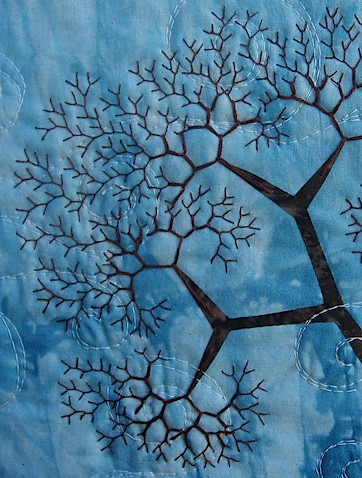
I decided to focus on fractals. A fractal is generally a rough or fragmented geometric shape that can be split into parts, each of which is (at least approximately) a reduced-size copy of the whole (according to wikipedia). I looked at some images of fractal trees and felt like I was going in the right direction. Trees appear regularly in my work, so that brought me closer to my comfort zone. Math is not anywhere near my comfort zone.

IMG_6175_2.JPG


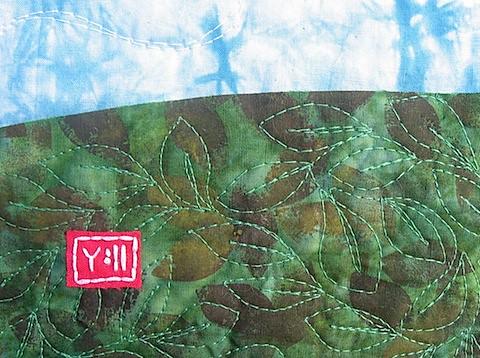
I started by picking a background fabric that made me think of a brisk winter day, a good setting for a tree full of bare branches. I stamped some brownish blackish yellowish shapes on the green fabric to represent all the leaves that might have fallen off the tree. I free motioned quilted leaf shapes on the hillside and swirly windy motifs in the sky area.

I cut the basic fractal shape for the trunk and large limbs, fused and then started stitching. Tons and tons of Y stitches. It's not an exact fractal since some limbs go off in just one direction. But I was amazed by the lovely fan shape that developed just by following the repetitive pattern. I started with three strands of floss just off the fused branches and switched to just one strand for the outer twigs.


IMG_6176_2.JPG


After all that stitching, I thought it might need something more. I posted my in progress quilt on my blog and asked for opinions. Usually we don't post our work until our big "reveal" date, but it was really interesting to read what people thought. Some said, "It's done!" Some thought it needed a little something. I thought it needed something too. I suppose that's why I didn't yet feel content with it. I appreciated the validation from my artist friends.
I decided to add a small Asian-style chop. Others had suggested a small bird, a single leaf or a snowflake, but I really wanted something unexpected. And the traditional red color of the chop seemed like just the right complement. Now what to put on the chop?! I searched for mathematical symbols meaning fractal or repeat, but I couldn't find anything. I suppose I could have looked for a Chinese translation, but I didn't want my chop to be too literally Chinese, nor did I want to stray that far from the math theme.

With my daughter's help, we remembered the musical symbol for "repeat," a colon followed by two parallel lines. I added the Y stitch followed by the repeat symbol. So, that seemed appropriate and emphasized the theme. Don't you think?

IMG_6177_2_2.JPG

Transcendental Curves

Transcendental Curve: a curve that is not an algebraic curve. . .

I have to admit, sometimes the mathematical premise behind my quilt makes some sense and other times I just can't get my head around it. Sadly, today is one of the later. My head is already starting to hurt, as so many of you have already expressed as a common reaction to higher math.
The imagery comes from Fourier Series and phasor vectors. The idea is relatively simple sine waves are added together in different phases to form more complex curves. These can be expressed with mathematical equations, or visually in a complex plane or periodic signal. I used the website Phasor Phactory to create visuals for one of these complex waves. The large image is the wave on the complex plane. The quilting lines are the periodic signal of the same wave. This is definitely a case where an artist rendering is much easier to understand than the mathematical explanation!

I did a lot of firsts for me with this quilt. I used traditional piecing for the background quadrants, but then fused the shapes within the curves. I also fused shears where the outline of the curve made a loop. I then used free motion zigzag to follow the line of the curve. Finally I did precision quilting to follow the exact periodic signal of the wave. I'm not one who usually follows a pattern--I tend to be very loose in my quilting--so sticking to the lines was rather difficult. My first attempt was awful, so I ended up redoing the whole quilt. I tried to use a plastic film as a guild, which I stitched over. In my test, it perforated fine and I was able to pull out the pieces. The problem was the tension was a mess with more bobbin than top thread showing. I solved the problem the second time by using water soluble stabilizer and the same bobbin and top thread. Here is a close up of the stitching so you can follow the lines of the curve.
I'm really happy with how the quilt turned out. This may be the beginning of series. Maybe I will try to tackle other mathematical concepts that are way over people's heads.

Simple Geometry


This is my very simple solution to a theme that did not capture my imagination, mainly due to the fact that I am up to my eyeballs in the work for my solo show. This is constructed from my hand dyed silks and organza for the geometric forms.

My original idea had to do with my ineptness when it comes to numbers and math. I was going to do a portrait of myself with spiky things emerging from my brain. On the right side the colorful spiky things would have had words like color, texture, pattern, etc. On the left side, they would have been blank. It was just too complicated for me to pull off. So I went for keep it simple, stupid!!

Counting on my fingers


At first the mathematics theme sounded so cold and unartistic to me that I confess I was a little put off. Like many people I can think of the "laws of mathematics" being unyielding things, insistently logical, to the annoyance of those of us who like to believe that everything has a little give, a little room for ambiguity. So I went looking for the human side of math and didn't have to look far. Right there at the end of my arm was the basis of the number system we use. The base 10 or decimal system evolved because human hands have ten fingers (digits) and so we build all our numbers from the basic 10 numerals, also called digits. Once you understand that, it is easier to think of mathematics as simply the system we have devised to make sense of and keep track of our world.

One of the more fascinating uses of a mathematical value is Φ (Phi) also known as the Golden Ratio. In mathematics and the arts, two quantities are in the golden ratio if the ratio between the sum of those quantities and the larger one is the same as the ratio between the larger one and the smaller. The golden ratio is a mathematical constant, approximately 1.6180339887. At least since the Renaissance, many artists and architects have proportioned their works to approximate the golden ratio—especially in the form of the golden rectangle, in which the ratio of the longer side to the shorter is the golden ratio—believing this proportion to be aesthetically pleasing. Mathematicians have studied the golden ratio because of its unique and interesting properties.* The golden ratio shows up in nature repeatedly, and the bones in the fingers of the human hand illustrate a nearly perfect progression of the golden ratio.
Imagine—finding all that mathematical information just by looking at my hand! My title is, of course, a pun. Of all the tools I use for my work, I rely most on my hands and count on my fingers.
I was pleased that I was finally able to use my rubber stamps and add words to my quilt. The fabric for the hand was fabric I stamped and painted. If you click for the larger view you may be able to see more clearly that I added some hand-stitched Xes, following the pattern of the background fabric. It wasn't until I was well into the stitching that I realized that X is also the Roman numeral for 10.
*Information about the golden ratio taken from Wikipedia.

A Malthusian Quilt

Math was never one of my favorite subjects, so when Nikki announced this challenge, I knew right away I probably wouldn't make anything with an Algebraic formula or a word problem. My challenge was to relate something "mathy" to something that interested me.


Quilts are inherently mathy with their geometric shapes, and blocks that are fractions in visual form. Even measuring patches requires math. After a few sketches though, I decided that traditional quilt blocks, or even tessellations and more modern treatments were too obvious. Finally, the phrase “You do the math” appealed to my ironic side that Terry says I seem to gravitate towards. It begged for some sort of comparison or statistics. For it to be meaningful to me, I figured I should look at women’s issues, or something close to home. It was in the writings of Jared Diamond that I ultimately found my theme.

In his book Collapse, Diamond refers to Thomas Malthus, an English economist and demographer, who is famous for the dilemma explained in his 1798 Essay on Population,
“The power of population is infinitely greater than the power in the earth to produce subsistence for man. Population unchecked, increases in geometrical ratio. Subsistence increases only in arithmetical ratio. A slight acquaintance with numbers will show the immensity of the first power in comparison of the second.”


I searched the internet for numbers to support Malthus' dilemma so that I might create a fabric chart to express it. My feeble scratch at the surface of this issue was hardly conclusive, but it provided lots of off-topic food for thought (pun intended). Irregardless of whether Malthus' Dilemma is proving itself out or not, the comparison of geometrical and arithmetical growth is in itself mathematical and thusly fits the challenge.


Using numbers from the UN's statistics website and the help of my Excel savvy husband, I drafted a chart showing the historic (since 1950) and projected population growth of the less developed countries in the world (that dramatic uphill curve growing towards an estimated leveling off near 8 billion people by 2050) and the growth of the more developed countries as shown in the thinner section between 1 and 1.5 billion people. I pieced this chart with feed sack fabrics for the obvious reason that it was appropriate to the discussion of feeding the world. Over these geometric curves are embroidered lines showing the arithmetical growth of major grain yields from 1950 to 2005. I left the ends hanging loose because there is no way to accurately forecast future grain production and possible breakthroughs. The quilt is bordered with small beads representing rice and corn.

Long story short, this chart quilt (and all charts are mathematical in basis) of a mathematical hypothesis is my take on the theme "Mathematics."

Change

In recent emails between the group a couple of us have commented on the importance of contemplation time for this challenge. Certainly this quilt was formed out of a set of random thoughts which had been swirling about for some time which suddenly clarified at 2am in the morning whilst I was waiting for the networks to declare Ohio in the US elections so that I could go to bed. My first thought when the theme was announced was of the current economic climate - see this post. Then I thought about working with fractals but had decided that such a small quilt needed something simpler and had been pondering binary code. Then, I was watching the BBC coverage and looking at the ever changing map of red and blue states. Change of course, being Obama's catchword was ever repeated and suddenly I remembered a story Dennis told me years ago.

He was behind a middle-aged woman at a shop till, rather grumpily wondering what on earth was taking her so long to make her purchase. When finally she was done she turned around and said, "I'm sorry I was slow. I'm just learning to count money'. Dennis told me because he was so impressed that she would make the effort at that stage of her life and that she was not ashamed to tell him. Change is indeed possible and one change that was happening on election night was that young people and old people who had never voted before were learning the importance of standing up and being counted.

The maths in an election is quite simple but produces the posisbilty for complex changes.

This quilt is made from a base layer of fabric fused to Pelmet vilene and edged using a tutorial I found on Terry's site. Then there is a layer of painted Lutrador cut into two sets of horizontal strips and hinged at either side embellished with little parcels of plain Lutrador tied with Perle thread. Those 'beads' represent the 'ones' from binary code. You may think also of voting papers. Over that is a layer of blue painted Lutrador cut into vertical strips embellished with stitch and sewn on pennies. ( which may explain the mystery in this post) The pennies are literally small change and represent not only the 'nought's of binary code but also the fact that with the current economic climate we are all facing potential change in finances which may reduce us to dealing with smaller sums of money. Hopefully this quilt is a reminder that beautiful things can be made from insignificant things. If change means simplification it is not necesserily a bad thing.

On each layer I allowed the grids to be a little uneven - change is never easy to co-ordinate with ecah of us starting from a different position and moving at a different pace. The strips can be woven at will to create a changing display on the quilt top, reminiscent of the changing electoral maps.

I think it is interesting that the quilt actually looks much better with a mix of Republican red and Democrat blue than with just one layer.