Thursday, July 12, 2012

Pachamama, the Earth Mother

From earliest times different cultures have revered a mother figure as representing the spirit of the earth, creativity, fertility and earth itself. Several years ago on a visit to Mexico City I visited the shrine of the Virgin of Guadalupe and learned that Guadalupe, a vision of the Virgin Mary, was perceived by the indigenous people of Mexico to be the embodiment of the Aztec Earth Mother, Coatlaxopeuh. This gave her acceptance among the population and made possible the acceptance of Catholicism in Mexico. The earth mother figure of the Andean cultures of South America is Pachamama. During the Spanish occupation of South America and the resulting forced conversion to Catholicism, the Virgin Mary was similarly accepted as a representation of the Pachamam by the indigneous people.


In researching Earth Mother figures I found that many times the Earth mother is depicted as young and  vital. In my mind I see the Earth Mother as ancient, wise, patient and benevolent, gently cradling the earth in her strong hands.


When I started thinking about this piece I pictured something more colorful and joyful, with a lot of flowers and greenery around a smiling mother figure. As it developed it seemed to want to be more somber. She has concerns for her children, I suppose.

Modern Day Medusa

Modern Day Medusa
20" x 12"
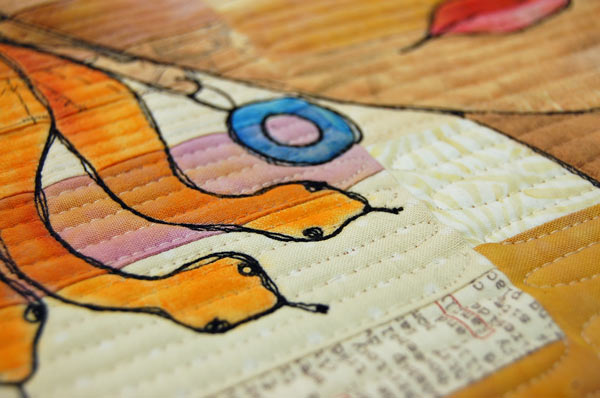
Medusa is from Greek mythology. It seems there are different versions of Medusa's story throughout history. At one point she is a monstrous and ugly being and during another time she is depicted as beautiful.  But most stories seem to agree that if anyone dared to gaze directly at Medusa, they would turn into stone. And for this reason, her image is often seen as a gate or door decoration as a symbol of being guarded by her.


It is said she was raped by Poseidon and became pregnant. When Athena found out about the rape and pregnancy, she turned Medusa's beautiful hair into snake-like serpents. Medusa was beheaded by Perseus while pregnant and as she died, Pegasus (the winged horse) was born from her.


My quilt is machine-pieced neutral fabrics that are then thread sketched and painted with Caran d' Ache Neocolor II Crayons.

Inari

I decided to make another quilt inspired by my travels to Kyoto. I first focused on Shinto, which is the old religion of Japan and is very rich in legends and myths.
Inari is an important kami. She's the goddess of rice, agriculture, business and probably other things too. Fushimi Inari is one of the main shrines where she's worshipped. It is located South of Kyoto.
The torii, the famous red gates of Shinto shrines, were one on the symbols I wanted to use in my quilt. I printed them with a homemade stencil.
The foxes, kitsune in Japanese, are Inari's messengers. I used a thermal screen and a homemade stencil to print them on my fabrics.
The multicoloured vertical lines were inspired by the origami cranes that are found in shrines and temples everywhere in Japan.
Of course, I had to dye indigo fabric for the background.
Here are two close-ups of my quilt...And a mosaic of my inspiration photos...

Flying to Close to the Sun

At first my plan was to illustrate one of the many wonderful Maori legends that I grew up hearing. Brenda mentioned Maui in a post a while back and I remembered a painting that I did as an 11 year old of Maui harnessing the Sun. In the time of Maui, the Sun moved so quickly through the sky that the people didn't even have time to finish their work before night was upon then. Maui, the Quintessential Peoples' Hero, harnessed the Sun with ropes and dragged on them to slow the day. I always liked my painting and remember well how I wanted it to look, although my skills at the time didn't allow me to attain my goal. But when I thought longer, I realised that it needed to stay as it was and the time was not yet right for revisiting it. So I kept thinking.

 After considering many obscure myths and enigmatic characters, I stayed with the sun and constantly was drawn to Icarus. Poor Icarus, who dared to dream of flight and flew so close to the sun that his (rather foolish) wax wings melted and plunged him to his death. I always felt it unfair that his ambition and hope met with such doom (maybe the lesson is that preparation is an essential aspect of ambition?! hmmm....I've clearly not learned that lesson!). I rather hopefully believe in points for effort...

The background for this quilt is paper-pieced on isometric graph paper. Fabric for the wings is painted with acrylic paint. The applique is fused, raw-edge stitched and then buttons sewn on top. I didn't have fun making it and it rather shows. Maybe my quilt experience parallels the subject!

Urban myth


It was an easy step to make to go from my last 20/12 quilt, 'Vilakazi Street', straight to urban mythology. My first step was to google South Africa Urban Myths and very quickly I found a list of myths about AIDS. One of those is that having sex with a virgin is a cure. Obviously acting on that belief has very negative connotaions for any uninfected adult involved. However, as I read further I found many links leading to the same story, a story which outraged me, which moved me and which galvanised me to make art about it at once. It says a lot about the fact I have done child protection work for many years that it did not suprise me.

I am conscious that others reading this blog may be less battle hardened though, so I have decided to walk a middle ground with this post. The link to the extra information that spurred me to make this quilt is here.

If you are here for pretty art and don't want to know more that's fine. The explanation that follows still makes sense. But, I make no apology for saying what I have said so far. I hope you will read the link, because this quilt was made not to shock for effect but to express my strong feelings that unless the world knows about the dangerous urban myths and debunks them, nothing will change.

In thinking how to visually portray the urban myths I got to thinking about how we cling to perceived truths to protect us even when there is no scientific evidence behind that belief. I have used the African amulet to symbolise the myths, referencing the tradition of placing a piece of writing from a holy book inside a pouch on a hunting shirt to give magical powers of protection. This amulet contains a list of urban myths about how to cure AIDS, wrapped in a piece of kuba cloth and bark cloth with additional wax print to represent the spread of AIDS all over the continent. ( On a momentary light note I nominate myself for the Most Odd Use of Prairie Point Prize). The Cowrie shells are an African symbol of life and regeneration. The amulet is hanging over a grid of streets and city blocks. The background is, like my other 20/12 quilts stamped and scraped with screen inks.

Underneath, I have literally taken the virgin cure myth, writ it large and ripped it to shreds.

Wednesday, July 11, 2012

More research

I am currently teaching at Quilt Encounter in South Australia. On our free day, a group of tutors visited the Art Gallery of South Australia. The gallery has a great book shop. Is it too late to do some more research?

Thursday, July 5, 2012

Twelve by Twelve Special Exhibit @ IQF Long Beach (26-29 July)

With generous sponsorship from the Thomas Contemporary Quilt Collection, we are thrilled to present both the Theme Series and the Colorplay Series, a total of 288 quilts!, on exhibition at the International Quilt Festival, Long Beach 26-29 July 2012. 

Myths in Manchester

Last week I went to see the We Face Forward exhibition of Contemporary African Art in the Whitworth Museum in Manchester. The first part however was a selection from their collection of tradtional textile pieces. I has already determined that my piece for the Mythology challenge involved the mythological beleif in the power of amulets so it was good to see an amulet covered hunters shirt which I had until then only seen in photos.

But the piece that amused me most was Aso Ikele (1948) by Victoria Udondian.
 

It is accompanied by a leaflet about its history. Which is complete baloney a carefully crafted myth about the origin of this supposedly historical African piece The artists bio says,

"Combining materials and narratives from Lagos and Manchester, Udondian weaves myths and histories into her own textiles, creating her own hybrids and questioning how stories become histories'.

Saturday, June 30, 2012

Nearing Delivery

I figured there was no point in looking in the cabbage patch or waiting for the mythical stork to deliver my next challenge piece so I made a start yesterday. I've had a concept design bubbling for weeks and my fabrics all ready to go but somehow I decided to create something completely different.  Just a little hand stitching and I'll be ready for 12 July.

Monday, June 25, 2012

Has anyone seen my klaf?

My Mythology quilt is well underway and needs just final touches. I have chosen to carry on my map theme, make it a little more abstract yet and to work with the concept of urban mythology. South African urban mythology, of course. You would, I am sure, expect nothing less of me.

So I am finding it a little hard to remember exactly why, given that I started with my idea from the get go and never deviated from its africanness, it was absolutley essential to the authentcity of the piece that I ordered a klaf.

From Israel, nontheless. A klaf being a piece of kosher parchment. And I mean animal skin partchment not paper parchment. So I paid a lot for a small (but irrelevantly religiously acceptable) piece of sheep stomach. Because it was vital.

And now I have lost it.

And I can't remember why I needed it.

What is wrong with me?!

Sunday, June 24, 2012

Myth making

My 12 x 20 piece for the myth theme is well underway, but I'm at a decision making point right now that I'm not very happy with.


I wanted to try layering three sheers over each other with the hopes that each one would influence the other. Brilliant right?  In theory only.  I am using silk organza from Exotic silk because it's very sheer, and I think it has the best possibility of working in this method.


I'm down to two layers now, hoping something will show up from the bottom piece.
I'm taking a class with Carol Soderlund this fall at Coupeville, Washington called Layers Upon Layers. Not soon enough for this piece, but I haven't given up yet.


Friday, June 22, 2012

A little progress

I've got the fabrics and the idea.Sewing time is scheduled for very soon.

Tuesday, June 19, 2012

Mission Mythology: Completed


Wow, I'm so happy to tell you that I've finished my mythology quilt. Here's a sneak peek. As you can probably tell, it's a face, and a female face at that. Once I figured out what I was going to do for this challenge I was itching to go with it. It seemed like forever since I had created a female face on a quilt. I can't wait to see what the other Twelves create in this challenge.

Monday, June 18, 2012

Slowly working

Deborah asked us where we were on our Myth challenge since it's been a little quiet here.

This is where I sit right now. Since I knew we'd be on the road for most of this challenge, I chose something pretty straightforward and very portable. I haven't had a lot of time to work on it amongst our visits and sightseeing, but it's coming along nicely, if slowly.

I prepared my "ground" before packing up to leave Hawaii, and filled a little bag with my thimble, lots of floss, a needle book, and tiny scissors. Now, when I have a quiet moment, I can pull out my work, and hopefully, by the 12th, have a nice little Myth themed quilt.

Saturday, June 16, 2012

Deep in Research

Where to even begin with mythology? It's so broad, right?

Desperate for inspiration and focus, I sat down and googled "asian mythology." Several people have used the word "zen" to describe some of my work and I am draw to an Asian spirit in my design. (Whatever that means...) So, it seemed like a decent place to start.

Eventually, I got to Buddha and that reminded me on an amazing exhibit I saw at the Crow Museum in Dallas. The exhibit was titled Traditional Transformed: Tibetan Artists Respond. I was particularly fascinated by Gonkar Gyatso's work.

Here is an image from Gonkar's personal blog from an exhibit at the Museum of Fine Art in Boston.

His work is also on the cover of this book.

His work takes many forms, but I really love the work he does with STICKERS! I'm interested in his very contemporary and pop-culture interpretation of such traditional imagery and mythology.

I remember spending lots of time at that exhibit in Dallas looking at a collage of stickers in the shape of a Buddah with the specific traditional proportions marked out. Something like this.

I could spend days and days looking at images of Buddha and thinking about the patterns, proportions, lines and decorative elements. In fact, I created a Pinterest board and I'm lost in Buddah rabbit hole.

Speaking of Buddah rabbit...