Wednesday, March 2, 2011

Book Release Celebration!
Introducing Chapter 1: Dandelion & Diane

Twelve by Twelve Theme Series Works by Diane Perin Hock

Hello, friends!  Diane here!

We are celebrating the release of our brand new book, "Twelve by Twelve: The International Art Quilt Challenge"with a chance to win a free copy of the book!  Over the next twelve days, we'll post a question each day and hope that you'll respond in a comment!  At the end of the twelve days, we'll randomly choose a winner (or winners!) from among those who have commented. Each comment you leave will count as a separate entry, so if you comment each day to answer each question, you'll have twelve entries! The book drawing is closed.  Stay tuned for the winner details.

We have learned so much about each other through our challenges, and now we want to learn about you, too!  So join in -- check each day to see what the question is, and do comment with your answer. 

In the book, I wrote the introduction explaining how our Twelve by Twelve group got started and how the internet has enabled us to form a cohesive group even though many of us have never met in person.  In the first chapter, I talk about how I chose the theme "dandelion," how my piece (pictured below) evolved, and how exciting it was to see our first set of challenge quilts revealed online.  Because the Internet has played such an important role in our challenge, here is my question:

We Twelves share our project using this blog, our website, and now our book.  We use Facebook to announce challenge reveals and other current news.  We also use a Yahoo group for our internal communications, to plan, chat, and deal with housekeeping matters. What technical and/or social media tools have you found useful in building or participating in a creative online community?  

Blowin' in the Wind by Diane Perin Hock

Tuesday, March 1, 2011

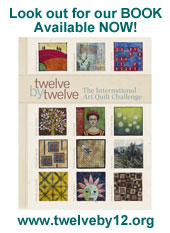
Introducing Twelve by Twelve: The BOOK!

Did you know that the collective noun for a group of larks is exaltation?  It could equally apply to the Twelves with all the excitement, exhilaration and heart-bursting wonderment we are experiencing as we take delivery of the author copies of our new book  Twelve by Twelve: The International Art Quilt Challenge published by Lark Crafts. Kristin received her books in Hawaii today and our mosaic is complete:
Today 1 March also happens to be the official release date for the book which is AVAILABLE NOW from a range of suppliers including:
We can't wait to share the BOOK with you! To celebrate, we will have a series of posts starting tomorrow 2 March introducing you to the book, artist by artist, chapter by chapter. We invite you to join the discussion as we pose a question each day and to enter into the draw to win your very own copy. In the meantime, you might be interested to read these reviews  by quilters and art quilters Virginia Spiegel, Pat Sloan, Rayna Gilman, and Kathie Briggs.

Introducing Chartreuse, My Favorite Neutral

Instead of a color palette, I want to mix it up a bit more and give us free reign working with this color that makes my heart sing. I think it will be very fitting for a spring reveal.
From Wickipedia:
Chartreuse is a color halfway between yellow and green that was named because of its resemblance to the green color of one of the French liqueurs called green chartreuse introduced in 1764. And, remember, this is not lime green. Chartreuse is a much more sophisticated color!
If you want to have some fun, go to this site and play with color combos: labs.ideeinc.com/multicolr/#colors=829b40;
To show you how versatile this color is, here are some photos to whet your appetite.


Bonsai Tree of Life


Wikipedia explains bonsai, in part, to be for "The purposes of ... contemplation (for the viewer) and the pleasant exercise of effort and ingenuity (for the grower)."

I don't claim to be a bonsai expert -- far from it -- but elements of bonsai seem to fit in well with my initial response to the color palette of "spa," a relaxing place for renewal and/or health.


In keeping with my self-imposed challenge to base my Colorplay pieces on traditional quilt blocks or patterns, this one was inspired by the Tree of Life, or Tree of Paradise block. The quilting is meant to look a bit like the raked gravel in a zen garden. The background fabric may be more chinese than japanese, but I did buy it from a japanese lady at an ugly fabric fund raising auction, so that's got to account for something! It took several iterations to get the right arrangement and scale of the half square triangles looking like a miniature tree, but I guess that was "the pleasant exercise of effort and ingenuity" for which bonsai is intended.

Southern Sky


I'm a New Zealander married to an Australian. We've been married twenty eight years and during that time we have lived in each country several times. There can't be any two countries on earth that have the close relationship that Australia and New Zealand have. Citizens are free to come and go in each country as they desire. We can live in either place and claim government support and healthcare. We swap emergency services staff when disaster strikes (Australian police and fire services staff are still in Christchurch now helping with the earthquake recovery). New Zealanders created a unique word for this kind of relationship - 'cuzzybro'. More than a cousin, almost a brother. It's a word that has kind of fallen from favour now, shortened back to 'cuz' or 'bro'. Kiwis are quick to call you 'bro'.

For all that, we do have many differences. One of the most obvious differences is the landscape. Each time I travel to between countries I am struck by the change in palette. Australia has big, big, blue skies and dusty vegetation. New Zealand often has greyer skies but the foliage is green - often brilliant green.

Here we are then, a gum leaf and a fern frond. Sharing the same sky but with a slightly different light.

Winter Tree Line

I couldn't escape the landscape ideas for this color palette -- I am just surrounded by too much brown, blue and sage outside my windows.  Okay, the  brown is more gray in winter, but I've been known to romanticize a thing or two in my mind.  We live in a little rural pocket outside of town, so my view is the mountains, trees and a run down barn. 

Winter Tree Line

Framing my view of Mt Jupiter are rolling hills covered in evergreen trees.  I simplified the trees into tall, skinny triangles and added a forest to the hill.  Each tree is swaying in the wind.  Here in the northwest, the trees near sea level aren't covered with snow, even after "winter storms" which usually end in very cold rain.  The sky is swirling with wind, even on the sunniest day.  I had to add the funky shell beads to the bottom -- they were just too much fun to pass by.  I then had to add the blue circles to the sky to balance them. 

I couldn't stop at just one quilt.  This was actually my first idea for the challenge. I followed the basic idea I had for another quilt, Joyful Bounty, and created a farm landscape.  I used circles to represent the crops and added that old barn.  Thinking about it now, I should also have added the broken down blue truck that hasn't moved since we've been here -- the color would have fit perfectly.  I added beads to the circles and finished the edge with seed beads.  The quilt doesn't quite have the joyful colors of summer I am used to working with.  Instead, it captures the slow growth of spring and the hope for eventual sunny days. 

Spring Thaw


Spring Suggestion

I've been inspired by bare branches lately. I've been working on three quilts over the last several weeks and they all include these wavy, linear, forked tree trunks.
Spring Suggestion

In fact, when I first began this quilt, I intended to simply have the navy background and the three trunks. I would add some free motion quilting and hand embroidery and let the trees stand on their own.

But, then I changed my mind and piled up a bunch more stuff on top. How could I resist using the hand painted brown fabric with the watery bits of green and blue?

This is another continuation of the shrine/altar composition that I use regularly and the house and plant symbols that are also familiar in my work. The brown felt leaf is a three-dimensional.

It really suggests winter turning into spring, don't you think?

I hadn't even considered the idea of green buds on brown tree branches against a blue sky when I first picked the palette. (Of course, I manipulated those ideas about color placement for this quilt, but it's the same concept.) The creative process is wonderfully unpredictable.

Flight Path


When Deborah first announced this color palette of brown, sage, and blue, the coolness of the colors reminded me of the soft, pale colors of a map.  I have a thing about maps, and have been slowly working on sketches for a series of map-related quilts.  And no matter how I tried to think about the sage green aspect of the palette (you knew I wasn't going to head for brown), I kept coming back to the blueness of a map.

That led me to sketching and looking at maps, and I ended up choosing a section of a place -- the area I grew up in as a child, in San Mateo, California -- to feature in this piece.  I wanted to present the lines and colors and shapes created by a map for their abstract beauty.  You'll notice that I didn't go with the overall blue after all.  At some point I had a vision of map lines snaking out onto a white background, and I decided to go there instead.

I considered different ways of getting the map onto fabric, but eventually decided to try something I'd seen on a Quilting Arts TV episode from the 600 Series.  On the show, an artist put water soluble paper through her inkjet printer, then used it to transfer an image onto fabric.  I didn't have water soluble paper per se, but I did have water soluble stabilizer and I printed an actual map onto it via inket, then pinned it to my white fabric and stitched over the lines I wanted with black thread.  When my stitching was done, I dunked it in water and wiped it gently until the paper dissolved.  It worked pretty well, although a few ink smudges transferred onto the white fabric.  Luckily, I was able to paint over them.  Once the stitching was one, I added the color with Tsukineko inks. 

And as I worked on this, I thought about my childhood home and the neighborhood and how one of the strong memories of that house was how much time I spent watching airplanes fly by as they started to head toward San Francisco Airport.  I'd sit at the big picture window in our living room, with my dad's binoculars, and identify the airline logos on the airplane tails.

So when I hit a point where I felt that this map just needed something more, I was inspired by Deborah's shadowy applique with tulle and I overlayed the shadow of an airplane with blue tulle.  

Quilting this was a lot of fun.  In the white field, I quilted more street-like lines. Here's a detail shot:


This isn't a palette I'd have reached for on my own, probably, but it was enjoyable working with these soft colors.  And working on this made me want to make something like this a lot bigger, so maybe this will be the piece that launches me into some larger map quilts.

Snoozing at the beach

As soon as I saw Deborah's colour scheme (Brown, sage, blue), I knew I wanted to do a beach quilt, and I also knew which pictures I would use as inspiration. I like the seaside very much, but here in winter it is so windy and cold that we don't go very often and I miss it.
I had to do several dyeing sessions before getting the soft shades I had in mind for this quilt. I then sewed a very simple beach view.
Next, I wanted to depict the seagrass growing in the sand dunes where I like to go and rest sometimes in the afternoon. I made a freezer paper stencil and printed the grass using oil paint sticks. I found the marks were a bit weak. So the last step, after quilting, was to go over those marks with machine stitching.
Here's a close-up...
I also wanted to add some hand embroidery, but I kept wondering if this quilt really needed anything more. So, after taking the photos (better safe than sorry), I added some tiny hand-stitched grass blades. But really, I don't know if I'm going to leave them.
I've posted more pictures on my blog.

Put an Aspen On It


When I saw Deborah's Colorplay palette, it spoke landscape to me. I love doing landscapes and I have done many with aspens, but never for the Twelve x Twelve challenges. So, I decided to put some aspens in this piece.

I used the landscape method that I learned from Sue Benner. The batting has a layer of fusing. Then I tore strips of fabrics in the color palette and created the background. This is then fused to the background and stitched.

I have more details on my blog. Here is a detail:

Falasha


Tonight I found a quote from Sas Colby, a mixed media artist.

Creative people can draw parallels between diverse ideas and things, connecting seemingly disparate notions to come up with something new.

That quote made me feel a whole lot better about what previously seemed to me to the be the dangerously frenzied pattern of thinking that resulted in this quilt. I am not mad. I am creative :)

To explain:
I had no idea what to do for this quilt. I had nothing. Zero. Nada. Panic was brewing.
To calm myself I decided I could at least go and pull out the fabrics I had which fitted the challenge. First I set on my desk a piece of fabric I made by rubbing Markal sticks over revealed plaster when my kitchen was being renovated. Then I tossed down a folded fat quarter of deep blue acquired at PIQF and it landed slightly off the edge of the original. I stared it it. I liked the accidental shape. I have made quilts on top of quilts before. I could do that again.

But then what to do with it? I still had no real idea save that I wanted to keep my African theme if possible. I rummaged in the scrap box for a piece of bark cloth. Set it atop the fat quarter and... well, doh! Of course. This was to be a quilt about Falasha. Obviously.

Really - that's exactly how it happened!

And what are Falasha you might ask? They are Ethiopian Jews. You can get a longer explanation here but in essence they are Jewish people who have been for centuries practising their faith in Ethopia. Some think them to be the lost tribe of Israel, some to be the descendant of King Solomon and Queen Sheba, others to have been converts to Judaism Whatever their origins by the time President Mengistu took over they started to have a rather bad time of it with 2,500 being killed and 7,000 made homeless.  Others were inmprisoned and all were forbidden to practice their faith. Ultimatley Israel orgainsed three sereis of airlifts under the names Operation Moses, Operation Joshua and Operation Solomon.  About 36,000 Falasha now reside in Israel.

So how on earth, I hear you saying, did she get to that? Well, simply, when I set the barkcloth vertically on the folded FQ it reminded me of a mezuzah - the small case containing parchemt on which scripture is written, which observant Jews place on the entry to their homes. The barkcloth comes from Africa, hence African Jews.


Once I saw the Falasha theme, the other symbolism rushed towards me screaming rather obviously to be included as I worked on the quilt. The bead on the sage background and with sage strings is an amulet. That refers back to my last Twelve by Twelve quilt but also to the common use of amulets to protect during travel - many of the Falasha had to endure a grueling journey on foot to Sudan to be airlifted. Many did not survive. The dangling strings refer to the tzizit which observant male Jews wear sticking out over their waisrbands from an undergarment -  they are knotted strings to remind them of the commandments. There is hand stiching from me which mimics the hand stitching already present in the African cloth. I did that in my last quilt too and it gives me pleasure to repeat a tradition from someone who went before me, just as the Falasha continue old religious practises. By repeating my own work I am also creating new traditions just as the Falasha introduced new ways of celebrations to Israel. The Mezuzah is almost straight but actually it is just slightly off, giving a slight uneasiness to the viewer. This reflects the experience of immigrant Falasha who have often found it hard to settle in Israel and have suffered discrimination from other Jews. They have been rabinically recognised as Jews, and yet....

The right hand side of the quilt is obviously quilted. This represents the overt Jewish life the Falasha may now live in Israel if they choose. The quilting pattern might be seen as desert pebbles or maybe champagne bubbles to celebrate their safe arival. The left hand side is more subtly handquilted representing the time in Ethopia when some discretion in their practise of their faith would have been necessary to survive. The quilting follows the marks on the fabric just as the Ethoipians followed the paths of fellow Jews in making Aliya to Israel. The hand quilting is broken representing the fractured families as some members have been left behind.


Just before I read the above quote I emailed Diane,  lamenting the fact that I felt a bit of a fraud. The rest of the group spend so much time on beautiful surface design and sometimes I feel I throw a quilt together quickly then pretend it is something profound to mask the lack of technique. Then I read that quote today and a lightbulb went on. My artist's life is not actually that disimilar from my lawyer life:  a good barrister can often distill piles of paperwork and months of client's anguish into a few succinct sentences and quickly wrap a case up much faster than that client expected. It is not that they cannot be bothered to spend a lot of time on the case but rather that they have spent so much time previously learning law and practising the craft of anaylsis and representation, that the years of study and experience result in a speedy resolution.

So it is I think for me. There is it seems an alarming amount of stuff in my brain just floating about in there being of interest. And given the right visual cue bits of it come flying out into the quilt. Why particular bits come out at particular times I have no idea but I am learning that in my search for a my quilting 'voice' I should not be suprised if what comes out through my fingers resembles what went into my brain through my eyes and ears. But I am looking forward to suprising myself again with the next challenge. And maybe to experiment by reading a lot about some entirely new topics and seeing how long the fermentation period is!

Line study two

My BrownSageBlue piece is another in what is turning out to be a series of line studies.  I started with the brown silk background which cooperatively turned into blue with a little discharge paste.  That set me on a path of continuing with circles.  The circles on the right side are made using a paper lamination technique.  I scrubbed it rather vigorously, which accounts for the lines you see between the circles.


That done, I added the circle on the left and started in with the handstitching.  Originally, I had fallen in love with a piece of chartreuse looking fabric I had and rationalized that it was almost sage, especially after Terry's blog about the different colors of sage.


I couldn't let it go though, and ended up covering it over with a more traditional sage looking fabric.

Puzzled Palette

This year I have been doodling and Zentangling more. I enjoy drawing these fun designs and I'm always amazed at the creativity of other artists. Shortly before Deborah announced this color palette, I came across a Zentangle pattern design named Struzzle. This design, created by Jo Newsham, intrigued me. I kept looking at it and thought it would make a fabulous quilt pattern.

I wrote Jo and asked her permission to use her pattern as my quilt inspiration for this challenge. Jo very kindly granted me permission. Thanks Jo!

I started by drawing the design to size and creating my template pieces. Next I collaged several different fabrics from each color family onto some stiff interfacing and then quilted each fabric-covered interfacing piece. I cut out my pattern pieces, placed them onto a black background fabric and stitched around each piece to secure it to the quilt. I finished the edges of the quilt with one of my favorite methods, couched fibers.

Rice Bowl and Bird revisited

 
This time around I had the idea to remake a previous piece that I did, using the new color scheme and some newer ideas for working. I talked about it several weeks ago on the blog and showed the original piece, "Rice Bowl and Bird" and some elements of the new piece, including an early attempt that I discarded. Interesting to me that when I showed those early starts several people didn't like the second bird as well as the first and thought I should use the first bird with the second bowl. I guess I hadn't made it clear that I wasn't finished with either the bowl or the bird. I knew that adding stitching to the bird would change it dramatically, and it did.



The bird is my favorite part of the whole thing.

I wasn't crazy about the colors we were given and took liberties with them, using a much bluer shade of green than the one Deborah showed, but a green that I think of as closer to "sage." The coldness of the blue, green, and brown were very hard for me like, so I added the rich, warm orange. It really seemed to be the warmth it needed.

I really loved my idea of remaking an old piece. I will do this again. I keep all my drawings so it is relatively easy to do. If you look at the first "rice bowl and bird" you can surely see the relationship between the old one and the new one, but there are significant differences too.

Summer's End

For me, this restful palette evokes the last days of summer - a time of blue skies, longer shadows and warm breezes. No doubt I am extremely suggestible as this challenge period and reveal date coincides with the official end of the Australian summer (1 March) and the view from my studio window incorporates hues of brown, sage and blue.
For my first piece (you knew there would be more than one, right?!), I concentrated on the shape and lines of the Norfolk pines that are typical of the Australian coast..
And so I present to you Copacabana Sentinels, a local landmark that is very useful for getting your bearings when you lose your contact lenses in the surf as happened to me recently.  (Fortunately, they were disposables!)
As simple and naive as the trees may appear, the piecing was surprsingly time consuming and the engineering quite challenging.  I fully intended to make another, more abstract version but I ran out of time.  Besides, for some unknown reason, I got sidetracked with the idea of monoprinting using my 12 1/2in square ruler as the plate as suggested by Sally Westcott when I met her last year.  Here are the prints with added painting and before quilting:
I swear I didn't have any particular images in mind in creating these designs but look what I just found in my photo archives from a walk around Cochrone Lagoon when my brother was visiting last week.  Well, when you live in such a beautiful place, I guess you can't help being influenced by your environment...
 
So this is my second piece:
I know which piece I am inclined to put forward as my official contribution to the BrownSageBlue challenge but I'm interested to hear your comments.

PS: There's also a very quick Summer Harvest study that you can see on my blog.